
Andy Smith talks about the importance of dreaming and dream like experiences and how to look for them..
I am writing this whilst preparing to teach a five day intensive facilitation training in London in February 2025. It’s called Collective Dreaming: Embodying new patterns for facilitation, relationships, communities and the world. It’s also marks the start of an exciting two year training called Facilitating the Future.
[10 minute read]
Dreams and Dimensions
We use the word dream in English to refer to similar but sometimes discreetly different processes. We might use it to refer to night-time dreams, day dreams, fantasies, or hopes, visions or nightmares.
Dreams exist in our minds for sure but also between us in our conversations and in the feeling states in the spaces we meet each other and share; they occupy a creative space. Dreams are sometimes described as not ‘real’, in the sense of being measurable and solid. Dreams are subjective and imaginative. Yet because dreams of all types feel real to us they are also essential catalysts, influencing not only how we act and interact with others but also how we relate to other part of ourselves or intra-psychically.
As a child I day dreamed frequently and was often told not to, as if it wasn’t proper. In a way i realised the voices from parents and teachers and sometime school friends that told me I was weird and strange (or so I was told) and I learnt to criticise myself when I was day-dreaming rather than seeing and appreciating that it was a creative and imaginative skill set I was developing. This dynamic between the natural process of engaging with imaginative and creative space and another role (that is cultural) that says doing do is nonsense or childish or weird is not new. Two hundred years ago, as the the so called ‘enlightenment’ or ‘age of reason’ was rising, it was very personally felt by William Blake and the generation of romantic poets and artist that came later.
Many of us will be familiar with Blake’s poem “And did those feet in ancient times” which contains an image of ‘dark, satanic mills’. But according to John Higgs in his book William Blake vs The World [1], Blake is not pointing at the mills of the Industrial Revolution but instead to a way of thinking – the rational, reason-bound, enlightenment ways of thinking that were spilling out of the production line in public schools and universities of his time. Creating people who had privileges and all thought alike. He was raging against this dominant and mechanical way of thinking that was gaining ground at the end of the 18th century.
He wasn’t against reason, though he was against it’s dominance, it’s certain way of applying thought and awareness that marginalises or forbids other ways of perceiving the reality of life on this earth, ignoring the creative feeling states and imaginative as well as spiritual dimensions that add so much.

Newton (1795–1805). Colour print with pen, ink and watercolour, 460 x 600 mm (18.1 x23.6 in). Tate Britain, London. Wikimedia Commons
This is exemplified in the famous print of Isaac Newton by Blake. In the picture Newton is shown sitting on a rock under the sea perhaps, almost like a god; very still, focussed on the one thing he is measuring whilst unaware of the beauty around and the mystery of reality that he is situated in. Actually the real Newton was a polymath who wrote as much about theology and alchemy [2] as what we call modern science and he held strong views on these mysteries. So perhaps Blake is not saying Newton was in deficit but he is saying that certain ways of thinking are too dominant, that this one-way of seeing was blinkered. And Newton was a human way of representing that archetype.
Blake had a vision of a unified human psyche that contained Imagination/Inspiration, reason, passion/emotion and sensation/body experience. Similar to ideas in processwork where we understand the yet to be unfolded process and how it can be discovered by applying awareness to less known parts of our experience.
In processwork training we are, like Blake, certainly not throwing out reason or suggesting that using reasoned ways of thinking impede us. We will be practicing using reason and deduction alongside, a number of other forms of attention, helping us learn to perceive and recognise dream like patterns as we enter and engage with dream-space collectively and individually
The experiences within and without us that we might otherwise be marginalising are key to understanding the process that is trying to emerge in any moment. Whether you are a facilitator , therapist, coach or counsellor, the type of awareness you bring and what and how you perceive makes a difference.
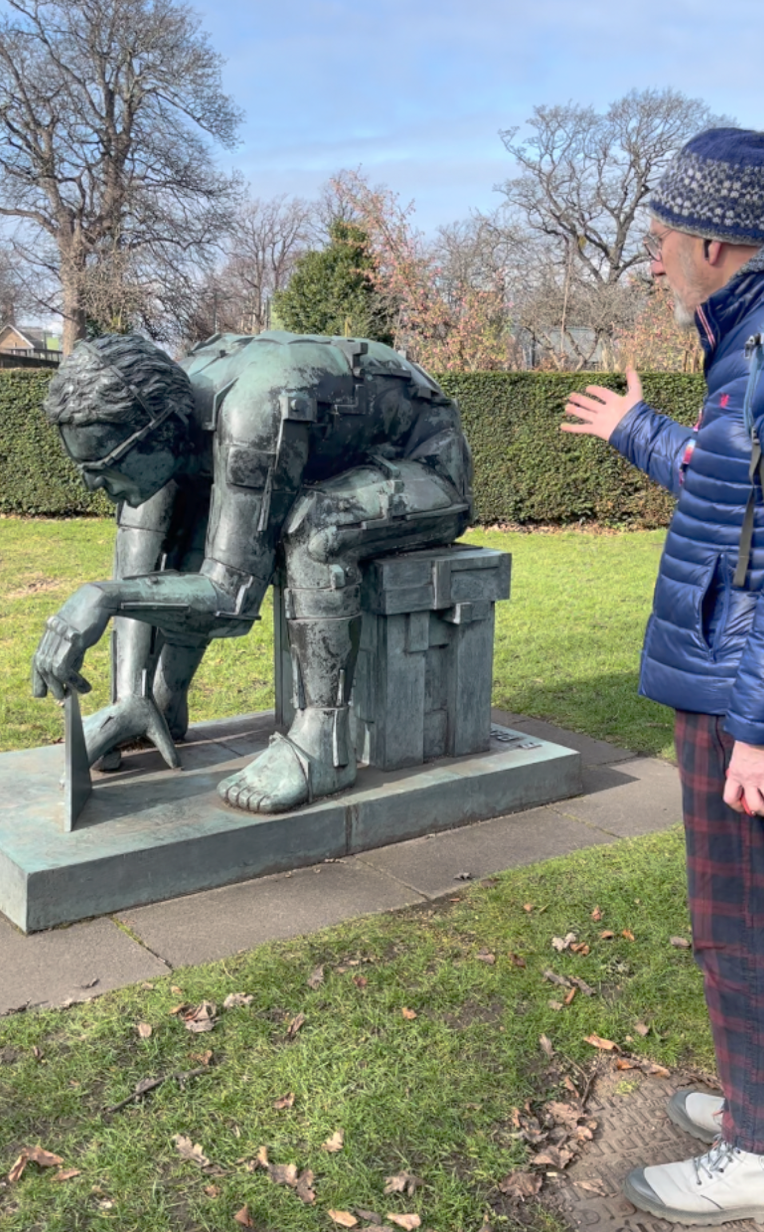
Photo of Eduardo Paolozzi’s Master of the Universe, or sometime called Newton after Blake. A more mechanised representation is sometimes understood as an integration of art and science.
When you have a body symptom whilst facilitating, take it seriously and explore it somatically until you get a sense of how it fits in the system you are part of.
When you become distracted or bored, consider how that might be a part of a system rather than an error in you.
When you have a fantasy or image in your minds eye whilst facilitating, perhaps that has a strange relevance you don’t fully now yet. So don’t dismiss it out of hand completely. Consider that it might fit somehow and check that out.
When you are facilitating groups and you notice something very subtle in the atmosphere then bring your awareness to bear there and enter into the atmosphere imaginatively to help you speak and intervene.
We teach methods to work like this during our workshops. This way of working is clearly imaginative and requires a different type of attention to what is happening when we are just our ‘usual’ selves. Partly in order to help navigate these different perceptions we makes use of a map to contrast different dimensions of reality.
Arnold Mindell describes three dimensions of reality – Consensus Reality, Dreaming and The Essence.
Consensus Reality is a temporarily agreed (although it feels very concrete sometimes) sense of what is real. Each culture and sub group within a culture may have a shared sense of what is real and what is true. But within cultures over time, things change, e.g. ideas of what are the right foods to eat, whether the earth circles the sun, or expected behaviours in different contexts and so on
And although the term Consensus Reality is a useful term – consensus doesn’t mean everyone within that society will agree all the time but more that there is a general agreed view on what is real. This can change when our awareness is expanded.
Dreamland refers to more subjective worlds, which for the reasons mentioned above, are often experiences we pay less attention to or push aside. Here there are dreamlike figures, and dreamy experiences. “Dreamland level work: explores these dreams, deep feelings, unspoken truths, “double” or unintentional body signals, “ghosts” (unrepresented figures) and ghost roles in the stories and myths of individuals and organisations. History, visions and trans-generational events are important.” [3]
The Essence is a dimension where we notice more intangible, deeper and non-dual types of experiences. Think of how you sense an atmosphere or remember certain feelings you might have when you visit certain landscapes where your sense of time and space alters naturally. “Essence level work includes : notice pre-feeling experiences that emerge later as images and ideas. Notice the atmosphere of a group or relationship. Explore field or system ideas…” [4]
Learning to recognise the particular dimension of reality that is being experienced by individual clients or group members can help immeasurably. As facilitators, we can miss some of the dimensions entirely or overly focus on one. For example, in organisational, community or group work Consensus Reality matters, the spoken rules, logistics, hardware, human resources and more but also Dreamland matters, the unspoken rules or patterns that have become second nature, dreams of hope and despair, systemic role patterns that happen without our realising them, the cycling of relationship issues. All of these have dream-like aspects. Persistent atmospheres in the organisation and the underlying myth or foundation of the group or organisation will have an essence like aspect.
Another example is my own work on Long Covid and chronic illness, where paying attention to as much Consensus Reality information as possible is key of course, but the many roles and ghost roles around chronic illness, the patterns of engagement with the medical system, the relationship work of internal criticism and unfolding the qualities and information contained in my symptoms are also needed. From the essence experiences of the slowness all contribute to the development of fluidity, awareness and personal transformation too
Processwork is deeply democratic toward all levels of experience: it values the freedom to explore and express consensus reality, dreamland and the essence levels. It understands all levels as equally important.
Every time you ignore sentient, that is, generally unrecognized dreamlike perceptions, something inside you goes into a mild form of shock because you have overlooked the spirit of life, your greatest potential power. [5]
——————————————
Awareness of how all the parts are interacting is key to the Worldwork paradigm and if you are interested in how to utilise the shared wisdom of our dreams, and difficulties to transform projects or help facilitate groups then the upcoming intensive training workshop in February 2025 might be for you. We will explore what is trying to emerge in our lives in our projects as new patterns that are shared with others. This intensive can also be taken as part of a longer two years Facilitation Training: Facilitating Our Future created with CFOR and which is now accepting applications.
Andy Smith (he/him) is a member of Processwork UK faculty. He is also a UKCP registered psychotherapist, supervisor, training supervisor and faculty member of the Spanish Processwork training programme. He centres his work on transformational change in communities, organisations and participative democracy, inclusion and diversity. This has resulted in international awards for educational design at both university and grassroots levels, with awards for inclusivity, diversity, changing workplace practice, lifelong learning. A GENE award for global innovation in education was recently given to the Go Deep Project.
––––––––––––––
[1] John Higgs 2022 William Blake versus the World.
[2] https://en.wikipedia.org/wiki/Isaac_Newton
[3] http://www.aamindell.net/process-work
[4] Ibid
[5] Arnold Mindell 2002 Dreaming While Awake
