
All I know for sure is that dreams are the pictures of states wanting to turn into processes. Dreams are maps of the beginning of an otherwise unchartered trip into the unknown.
Arnold Mindel
I am writing this whist preparing to teach a five day intensive facilitation training in London in February 2025. It’s called Collective Dreaming: Embodying new patterns for facilitation, relationships, communities and the world. It’s also marks the start of an exciting two year training called Facilitating the Future and a shorter course, January – May 2025 on Movement as a Path to Wholeness.
See below for links and more information.
This is part of a series of short pieces exploring the connections between individual experience and the collective field.
Collective Dreaming and me/we
If like me, you grew up in the global north you may have been educated (1) and conditioned to see ‘yourself’ in this highly individual manner. Your difference from others has been emphasised, described, delineated and discerned through schooling and parenting and society itself.
When I first started studying Jungian psychology and then Processwork I was fascinated and excited by something the process of individuation. Individuation can imply a future wholeness that we are being pulled towards. It is a lifelong task to unfold the deeper Self, become more myself, more differentiated from others, more whole. I bought in wholeheartedly to this idea, enjoying the adventure of personal growth and what I thought would be a life long journey. Already at that time, in my work as a facilitator and activist I knew I needed to be more myself and more at home in my work. I found teachers that helped me in my endeavour.

Crossing to Lindisfarne at low tide – St Cuthbert’s Way, Northumberland
Yet, perhaps, there is something seductive at play when we think of the Self in a way that amplifies our individual nature as a separate or unique beings. It is more complex because we too are more complex in how we are coupled with and are part of this world. Our body, we are taught is separate and yet in nature and our networks and relationships, the roles we take and any sense of purpose we connect to, we are interconnected, coupled and linked.
I am, according to one narrative, a separate and unique being, standing alone in a way. My life task or challenge is to figure out my own purpose and destiny, defeat monsters and face challenges and make my way in the world.
This idea of the individual separate self, has roots going way back, through ancient times, feudalism (2) and then more recently, colonialism, enlightenment thinking, neoliberalism and its connection to sexism, racism, ablism, class and more.
This idea of the rationale, individual, self-contained person is found amongst the stories we weave, the myths underlying the fabric of our culture. We find it in biography, novels, movies, memes and all sorts of messages. And these old ideas are still prevalent, even though they came into being well before we know what we know now; that we are not as separate as we would like to think.
Ecological Self
It makes more sense to me nowadays to think of us as ecological beings. We are part of systems that are bigger and more dispersed than we are, we are not separate, our skin is permeable, we contain and depend on many other life forms and systems within our bodies. When we walk in forests, parks, in the hills or beaches we not only change those landscapes but we are changed by them. It’s easy to miss this point of how we are co created, but the conundrum Francisco Varela (3) invites us to consider helps us re-orientate when he asks, ‘does the bee dream the flower or does the flower dream the bee’?
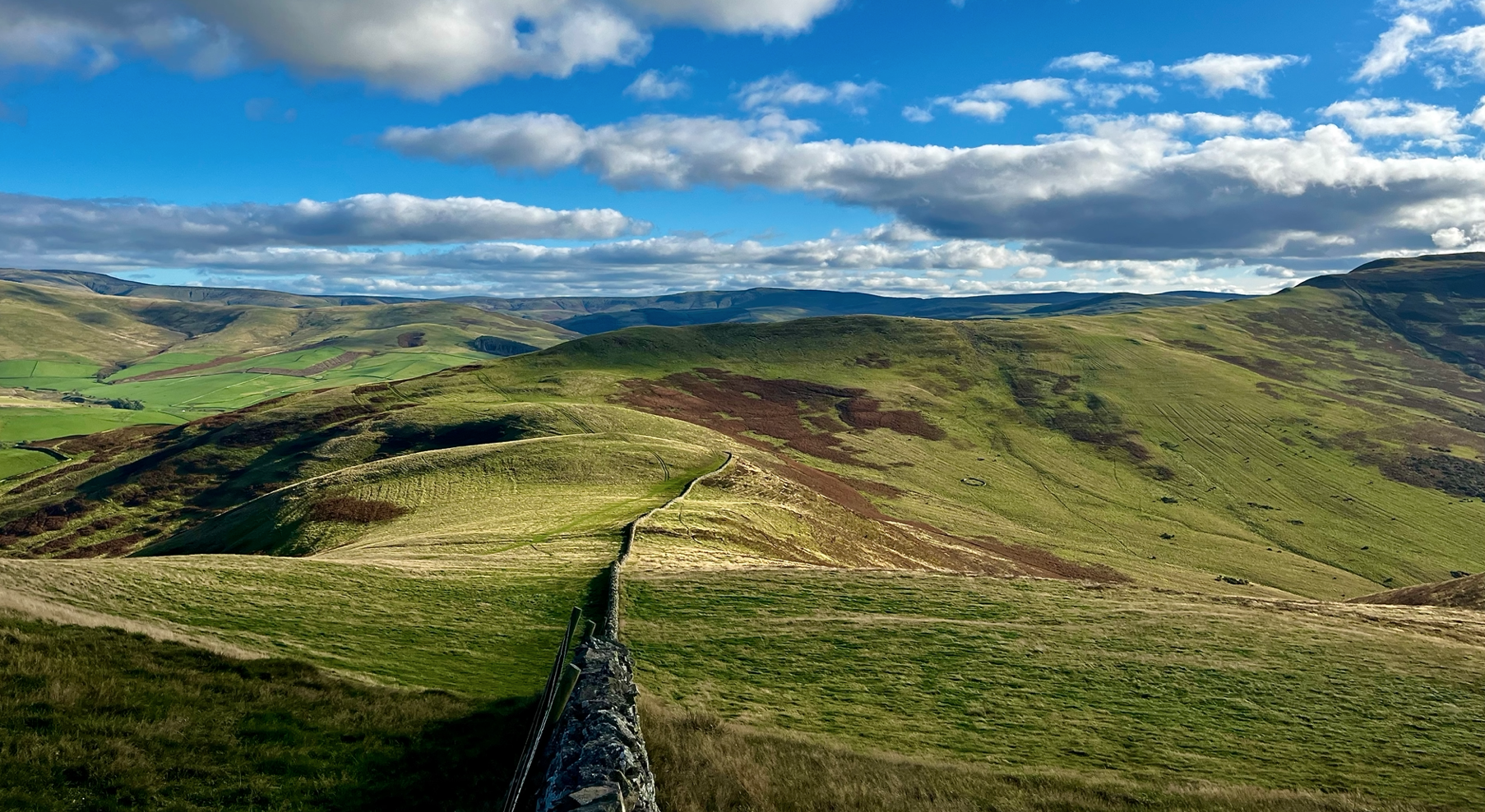
Landscapes – we change them and they change us when we walk – ‘Wide Open Hill’ on St Cuthbert’s Way, Scottish Borders – photo Andy Smith
In the same way, we can be many different people depending on the social context. What we think of as ‘the self’ exists within contexts and is relational. We are born into a specific time and place. If we had been born into different times and places we would be different.
Mainstream scientific research continues to explore these area, yet so many similar aspects are in indigenous and older traditions too. Using innerwork methods developed by Arny Mindell (4) and others, I might become increasingly aware of the ‘out there’ and how it corresponds to my internal sense of self. Or as Daniel Siegel (5) says with awareness you are not necessarily Alone when in nature but depending on your awareness more All–One! or intra-connected, By dropping my awareness and letting go of the self then I become something that is more than whole. I become something that is very real, changes me and my relationships although is not measurable in a strict scientific sense..
This is why working on our dreams together, using methods that emphasises the field we live in and share, has such an impact. The role and focus of the facilitator is within this context of discovery about how we are interconnected, intra-connected and entangled together.
A key part of processwork thinking is awareness based. In how you as a facilitator can access a position of awareness where you can sense and be open to the multiple levels present when a group or individual is working.
One person’s dreams or challenges are not necessarily their task alone (6), they may belong to their family, to organisations or there is a process that needs to live in or change the socio-cultural field (7). As dreams spring up from many sources they also emerge within contexts, at particular times and places and so that others of us can be part of them, to help to unfold the dream’s deeper meanings.
————————————
Awareness of how all the parts are interacting is key to the Worldwork paradigm and if you are interested in how to utilise the shared wisdom of our dreams, and difficulties to transform projects or help facilitate groups then the upcoming intensive training workshop in February 2025 might help. We will explore what is trying to emerge in our lives in our projects as new patterns that are shared with others in community and organisations. This intensive training can also be taken as part of a longer two years Facilitation Training: Facilitating Our Future is also now available in partnership with CFOR.
Andy Smith (he/him) is a member of Processwork UK faculty. He is also a UKCP registered psychotherapist, supervisor, training supervisor and faculty member of the Spanish Processwork training programme. He centres his work on transformational change in communities, organisations and participative democracy, inclusion and diversity. This has resulted in international awards for educational design at both university and grassroots levels, with awards for inclusivity, diversity, changing workplace practice, lifelong learning. A GENE award for global innovation in education was recently given to the Go Deep Project.
—————————–
(1) Tyson Yunkaporta 2019 Sand Talk pp123
(2) Silvia Federici Calaban and the Witch
(3) Monte Grande: Was Ist Leben? 2004 Documentary by Franz Reichie
(4) Arnold Mindell 2019 The Leader’s 2nd Training: For Your Life and Our World
(5) Daniel J. Siegel 2023 IntraConnected: MWe (Me + We) as the Integration of Self, Identity, and Belonging
(6) Arnold Mindell (ibid)
(7) Podcast featuring Abigail Echo-Hawk. A member of the Pawnee Nation of Oklahoma, Echo-Hawk is the Executive Vice President at Seattle Indian Health Board and the Director of the Urban Indian Health Institute. on different types of dreams and callings. https://open.spotify.com/episode/2tg5G4YdrRsOBZ16yU19vp?si=VKfd71zUTgqGx0WR2oSMRA
